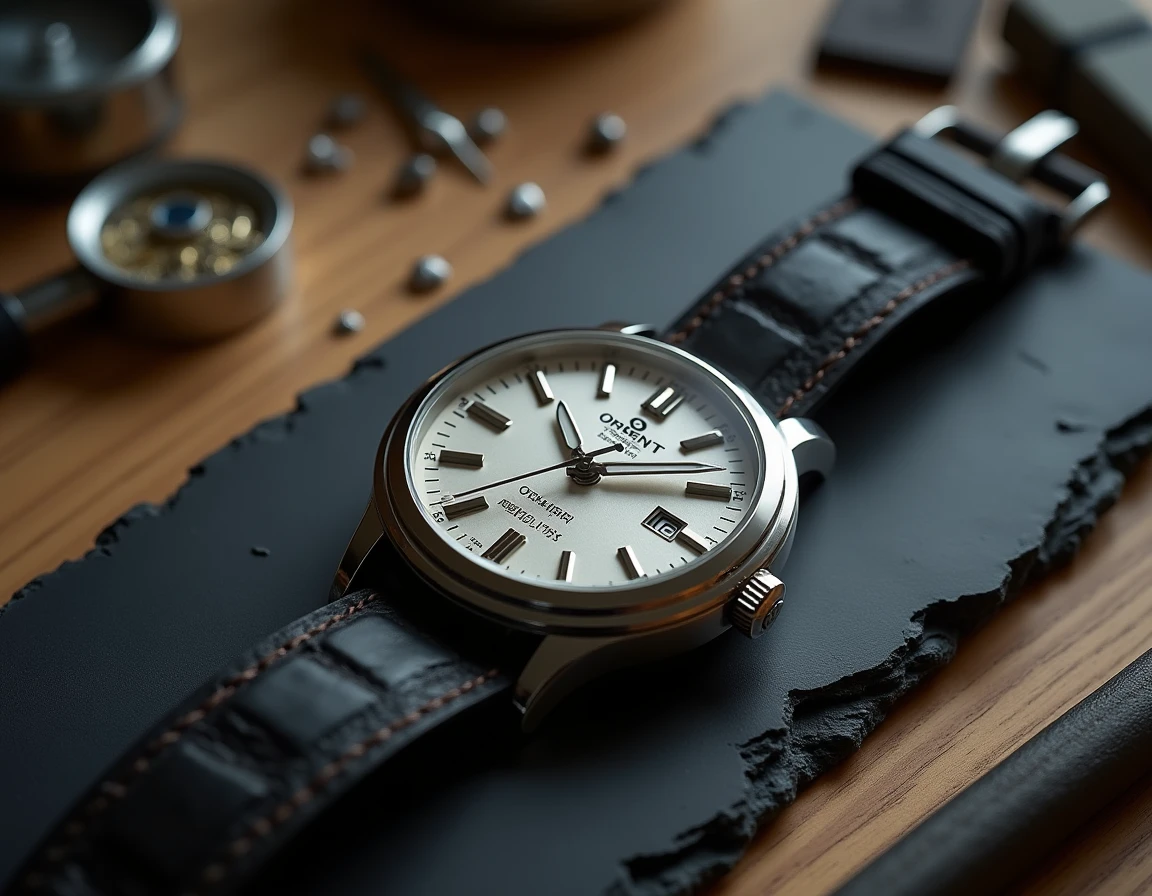
You come across an Orient Bambino at a bargain price on a marketplace, the dial looks correct, and the logo seems well placed. You place an order. Upon receipt, the case back creaks under your nail, the second hand jumps, and the warranty card looks like a color photocopy. This scenario frequently appears on French-speaking watch forums, and it almost always targets the same references.
Orient Counterfeits: Targeted References and Those That Aren’t

Counterfeiters do not copy just any Orient. Feedback from collectors in specialized groups converges: counterfeits almost exclusively target the Bambino, Kamasu, and Mako 3, which are the most visible models online and the most sought after by novice buyers.
More niche series (small case dress models, limited regional editions, ranges reserved for the domestic Japanese market) remain very rarely counterfeited. This contrast provides a useful first filter: if you buy a Kamasu on an unknown site, your vigilance should increase. If you find an Orient Star Retrograde on a enthusiast forum with a sales history, the risk is significantly lower.
This risk criterion by range is rarely mentioned in general guides, but it concretely guides the authentication process. To learn more about Flash Wave, the site details the specific checkpoints for each model family.
Hybrid Assemblies: The Orient Counterfeit That Traps Experts
The fake “complete” Orient (case, movement, and dial entirely counterfeited) exists, but a more insidious trend is developing. We are seeing the emergence of hybrid assemblies that combine authentic parts with counterfeit elements. The principle: take a genuine entry-level Orient case or bracelet, then insert a printed dial with the Orient logo and a generic movement (like Miyota or Seiko NH35) instead of the in-house caliber.
This type of assembly deceives more than a full copy. The bracelet has the right weight, the links articulate correctly, and the case may even bear a genuine serial number. The problem lies inside.
Identifying an In-House Orient Caliber
Orient has been manufacturing its own movements since the 1950s. On recent mechanical models, calibers are identified by a code (F67, for example, for certain Bambino). These calibers bear the “Orient” or “Orient Epson” inscription engraved on the plate, visible when opening the case back.
- A generic NH35 or Miyota 8215 movement instead of an in-house Orient caliber is an immediate red flag, even if the rest of the case appears authentic.
- The winding wheel and the arrangement of the bridges visually differ between an Orient caliber and a third-party movement: you can compare with reference photos available on specialized forums.
- On transparent case backs (exhibition caseback), check that the rotor bears the Orient logo and not a generic inscription or a smooth rotor without markings.
Having a watchmaker open the back costs a few euros and instantly clears up doubts about models with solid backs.
Warranty Card and Documents: What Recent Fakes Poorly Imitate
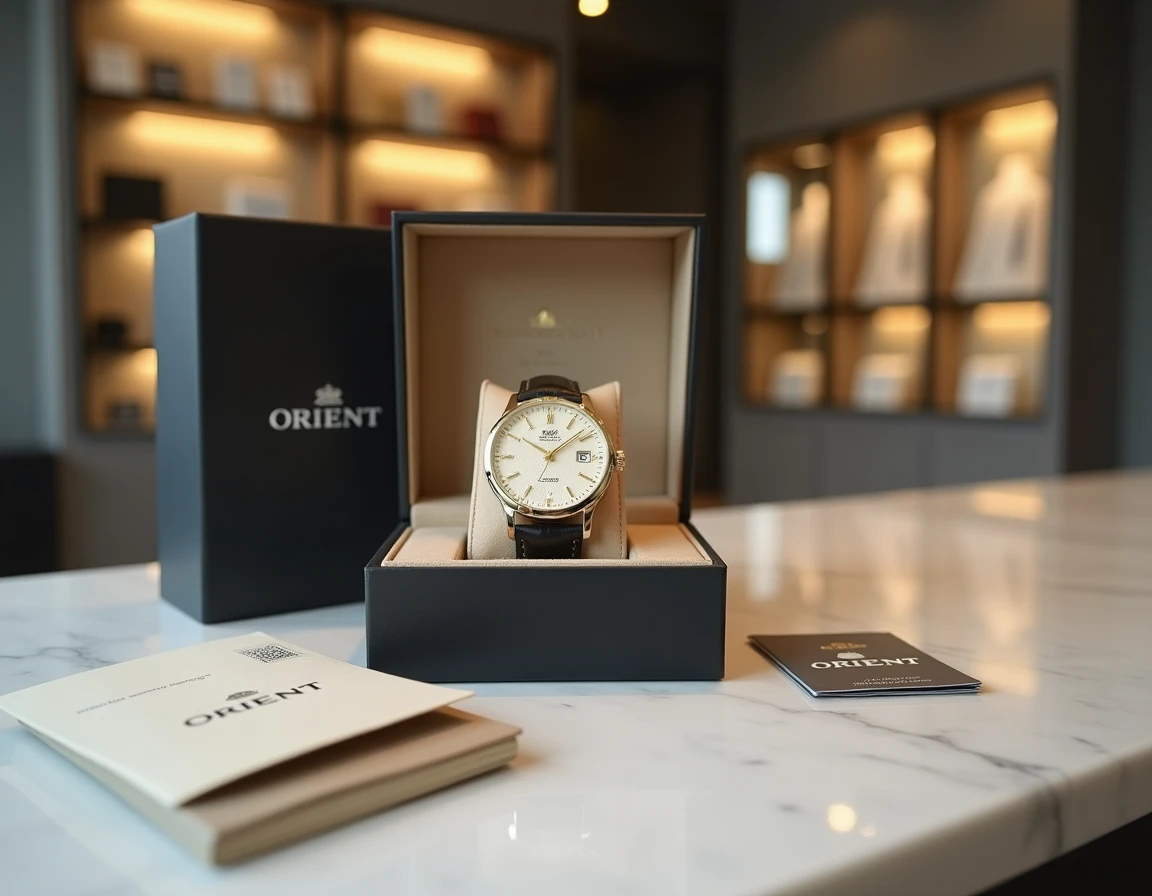
Since Epson harmonized the international distribution of Orient, recent models come with warranty cards and multilingual booklets in a standardized format. This standard includes a specific card design, sometimes accompanied by a QR code, and a booklet whose layout matches the official visuals from the Orient website.
Counterfeits rarely reproduce this packaging accurately. We often observe anomalies that are visible to the naked eye.
Checkpoints on the Documents
- The warranty card must match the current Orient design at the time of the model’s production. An old-format card for a recently released model indicates an inconsistency.
- The QR code, when present, must link to a functional Orient or Epson page, not to a 404 error or a third-party domain.
- The multilingual booklet contains text in several languages with proper typography. Counterfeits often have spelling mistakes in the French or German versions, or a thinner paper than the original.
- The serial number on the card must exactly match the one engraved on the case back. A blurry, misaligned engraving or one with visible burrs indicates a problem.
Physical Checks on the Orient Case and Dial
The finishes of a genuine Orient watch are distinguished by a consistency that counterfeits struggle to replicate in fine details. We are not talking about gross defects, but rather micro-indicators that can be spotted with a bit of method.
The applied indices on the dial must be perfectly aligned with the graduations of the rehaut. On a counterfeit, even a slight misalignment between an index and the corresponding minute reveals a rough assembly. This can be checked by placing the watch under a grazing light.
The Orient logo printed or applied on the dial deserves special attention. On authentic models, the stylized double “O” has sharp edges and uniform thickness. Fake dials often show a slightly blurred logo or one that is misaligned with the central axis.
The Glass and the Crown
The majority of recent Orients use mineral glass or, on higher ranges, sapphire glass. A glass that scratches easily with a metal point on a model that is supposed to be sapphire indicates a counterfeit. The crown should press in and screw down (on diver models) with a gradual and consistent resistance, without lateral play.
The overall weight of the watch is also an indicator. Counterfeits often use less dense materials for the case, resulting in a watch that is noticeably lighter than an authentic stainless steel model. Feedback varies on this point depending on the batches of counterfeits, but the weight difference remains perceptible when you have the original reference in hand.
Buying an Orient from an authorized dealer remains the most reliable method to avoid these traps. For the second-hand market, cross-checking (caliber, documents, finishes, reference consistency) reduces the risk to a very low level. An authentic Orient at a fair price is always better than a good deal that ends up in a drawer.