When imagining your future pool, the bench often plays a part in the dream. An immersed space to sit, read a book with your feet in the water, or watch the children without swimming. The problem arises when it comes to determining its dimensions: too narrow, you slip; too wide, you encroach on the swimming area. The width and height of this bench directly affect the seating comfort and daily use of the pool.
Why the ergonomics of the body dictate the dimensions of an immersed bench
Before discussing centimeters, it is essential to understand what happens when you sit in water. The body partially floats. The thighs need sufficient support to avoid drifting forward, and the feet must touch the bottom of the pool or the lower step.
A seat that is too high places the knees above the surface: uncomfortable after a few minutes. A seat that is too low forces you to curl up, with your chin brushing the water. It is this relationship between leg length, buoyancy, and pool depth that determines the correct height.
For the width, the principle is the same. Imagine a public bench that is twenty centimeters deep: no one would sit there. In the water, the seat must support at least two-thirds of the thigh to provide real rest. Choosing the width and height of a pool bench thus involves combining simple anatomical data with the configuration of your pool.
Height of pool bench seating: the effective range
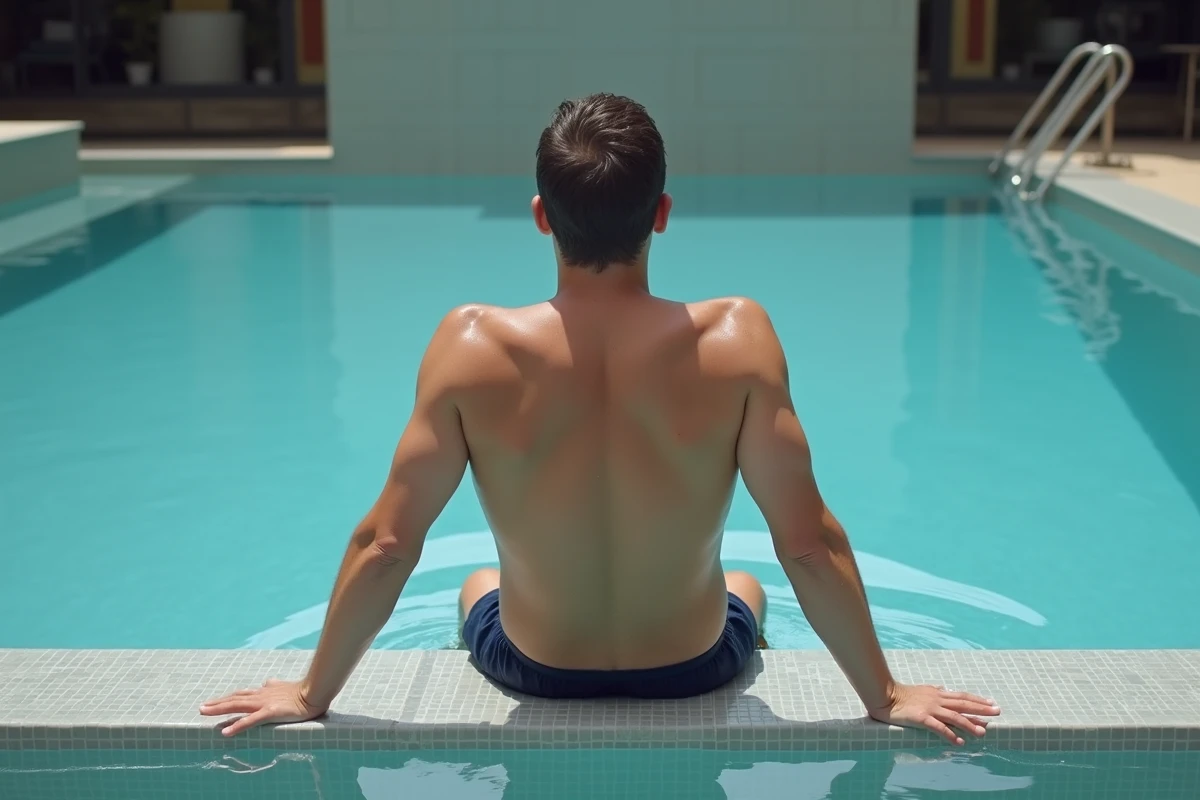
Most polyester shell manufacturers (Magiline, Alliance Piscines, Génération Piscine, Piscines Ibiza) mold their benches to a seating height located around 30 to 35 cm below the waterline. This is no coincidence: this range corresponds to the height of a standard chair, adapted to the buoyancy that lightens the weight of the body.
At this depth, an average-sized adult keeps their shoulders above water while having their thighs well supported. Children, on the other hand, have water up to their chest, allowing them to play without the risk of submersion.
Adjusting the height to the total depth of the pool
You may have noticed that some benches seem perfect in one pool and ridiculous in another? The reason lies in the relationship between the total depth and the height of the seat. In a shallow pool (about one meter), a 35 cm bench leaves barely 65 cm of water below. The feet quickly touch the bottom, which works well.
In a deeper pool, the same bench places the feet in mid-air. Adding an intermediate step under the bench solves this problem and makes entering the water easier. This is also what technical guides compliant with the NF P90-100 standard for accessibility for people with reduced mobility recommend.
Width of pool bench: the compromise between comfort and swimming space
French manufacturers’ catalogs show a clear trend: standard benches measure between 55 and 70 cm in width. This range represents the compromise adopted by the industry between seating comfort and maintaining usable swimming length.
Below 50 cm, just a ledge
A bench that is 40 or 45 cm wide does not allow for comfortable leaning back. You perch more than you settle in. This format is suitable as a step or footrest, but not as a space for prolonged relaxation.
Beyond 80 cm, an immersed beach
Once you exceed 80 cm, you shift into the concept of an immersed beach. The use changes: you lie down, placing a water sunbed there. Comfort is maximized, but the swimming space decreases accordingly. In an 8-meter long pool, an immersed beach one meter wide eliminates more than 10% of the usable length for swimming.
The choice therefore depends on the priority given to the pool. Here are the criteria to evaluate:
- The total length of the pool: below 7 meters, every centimeter of bench noticeably reduces swimming.
- The number of simultaneous users: a large family needs a wider bench for several people to sit comfortably.
- The primary use: if the pool is mainly for relaxation, a width of 70 cm or more is justified; if it is a sports pool, 55 cm is sufficient.
Shape of the pool and position of the bench: choices linked to dimensions
A bench placed in a corner of a rectangular pool does not pose the same constraints as a bench across the entire width of the short side. The position in the pool influences the perceived width and actual comfort.
In a corner, the bench forms an L shape. The two sides serve as natural armrests, compensating for a slightly smaller width. A 55 cm seat in the corner offers comfort comparable to 65 cm on a straight wall because the body is supported laterally.
Across the entire width of the pool, the bench becomes a true landing. It often serves as the first step of a staircase. In this configuration, maintaining a landing depth of at least 60 cm aligns with the accessibility recommendations for people with reduced mobility, which advocate for a stable support.
The impact on water circulation
A rarely discussed point: a wide bench alters the hydraulic circulation of the pool. The return jets located on the opposite wall send water against a flat, wide obstacle, which can create a dead zone behind the bench. Planning an additional return under the bench prevents the accumulation of algae and debris in this poorly circulated area.
- Check the positioning of the jets relative to the bench before finalizing the plan.
- Plan for more frequent cleaning of the horizontal surface of the bench, which retains deposits.
- Consider a shifted skimmer if the bench occupies the side where it was supposed to be placed.
The dimensions of a pool bench are not chosen from a catalog but by cross-referencing the users’ morphology, the size of the pool, and the desired use. A seat height between 30 and 35 cm and a width between 55 and 70 cm covers the vast majority of cases. The remaining decision is between swimming space and relaxation comfort, a choice that only the future owner can make based on their actual habits by the water.