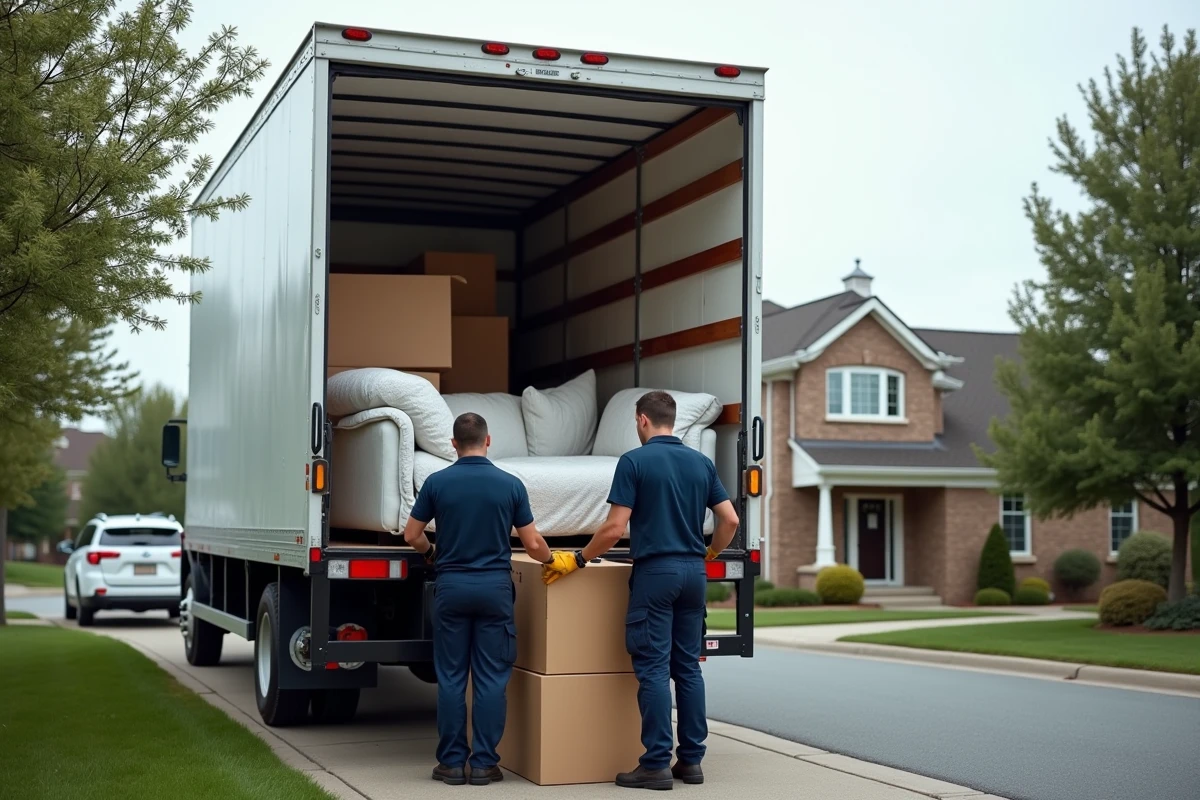
A 20 m³ truck remains the most rented vehicle by individuals changing homes. However, its displayed capacity obscures a crucial parameter: the weight that can actually be loaded. The available volume tells only part of the story, and confusing cubic meters with payload can lead to costly, even dangerous, loading errors.
Payload of a 20 m³ truck: the factor that volume does not reveal
When discussing a 20 m³ van, the reassuring round number is often the first thing that comes to mind. But the real constraint often lies with the weight. Depending on the models available for rent, the payload can vary significantly from one vehicle to another, sometimes enough to prohibit the transport of certain heavy furniture or dense materials.
A truck equipped with a liftgate illustrates this discrepancy well. The mechanism of the liftgate consumes a significant portion of the allowed payload. As a result, at the same volume, the transportable weight decreases. For a move that includes an upright piano, a safe, or boxes of books, this difference becomes critical.
The GVWR (Gross Vehicle Weight Rating) listed on the registration certificate sets the legal limit. The payload is deduced by subtracting the empty weight of the vehicle. In case of exceeding this limit, penalties range from fines to the immobilization of the truck, not to mention the risk of accidents related to degraded braking. Therefore, before loading, it is essential to know precisely the contents of a 20m3 truck in terms of weight as well as volume.
Interior dimensions of the 20 m³ and bulky items: what fits and what doesn’t
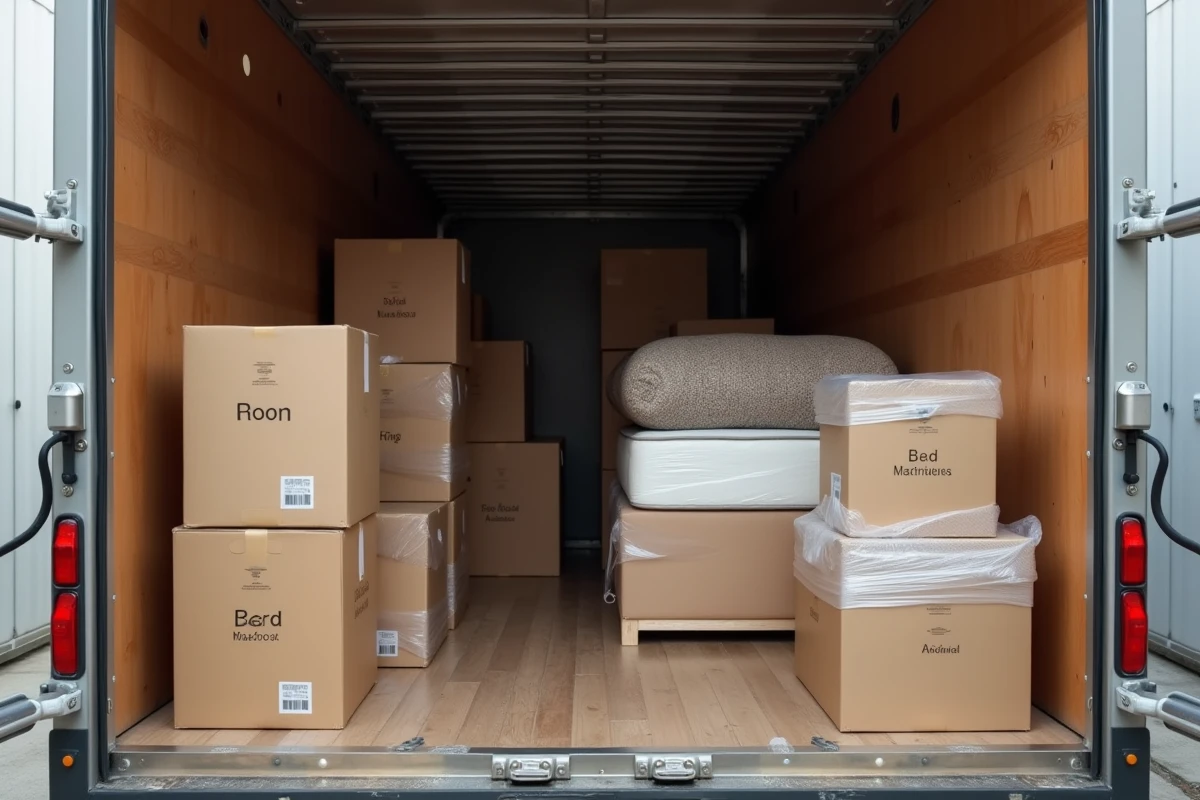
The common interior dimensions of a 20 m³ truck are around 4 meters of usable length, just over 2 meters of width, and about 2.30 meters of height under the ceiling. These measurements seem generous, but they impose precise constraints as soon as atypical items are loaded.
A standard corner sofa, for example, fits flat without any problem. However, a wardrobe 2.20 meters high may need to be laid down, which takes up floor space and complicates stacking. The usable height is often the limiting factor for non-dismantlable furniture.
What a 20 m³ absorbs for a typical T3 apartment
For a 40 to 50 m² apartment, the volume of furniture generally corresponds to what this truck can carry in a single trip. Specifically, this represents:
- A double bed with its base and mattress, a dresser, a bedside table, plus a single bed or a desk for a second bedroom
- A two or three-seater sofa, a coffee table, a TV unit, a dining table with its chairs
- A refrigerator, a washing machine, and several dozen standard boxes (dishes, clothes, books)
This scenario assumes that dismantlable furniture is indeed taken apart. A king-size bed left assembled, for example, occupies a disproportionate amount of space compared to its weight.
Urban access and external dimensions: an underestimated operational issue
Contents describing the capabilities of a 20 m³ truck often overlook a practical aspect: the external dimensions make this vehicle unsuitable for many access points in the city. Underground parking, narrow alleys, porches of old buildings, low-height bridges: the list of obstacles is long for a vehicle whose total height often exceeds 3 meters.
In a dense urban area, this constraint may require parking a distance away from the loading or unloading point. Every additional meter of carrying by foot extends the moving time and increases the risk of damage to the transported items.
For a move in a constrained city center, a more compact 12 m³ van making two trips may prove more efficient than a single trip in a 20 m³ truck that cannot approach the building entrance. The choice of truck depends as much on the address as on the volume to be transported.

Uses beyond moving: transport of materials and professional loads
The 20 m³ truck is not just for moving. Construction professionals use it to transport drywall, insulation panels, or construction materials. Retailers use it to deliver furniture, salon equipment, or batches of goods.
In these professional use cases, the issue of weight comes back strongly. Construction materials rarely fill the 20 m³ before reaching the payload limit. A load of bags of cement or tiles, for example, saturates the weight capacity long before filling the available volume.
Simple rule to balance between volume and weight
- Light and bulky load (clothing boxes, flat-pack furniture, mattresses): volume will be the limiting factor, the 20 m³ is fully justified
- Dense and compact load (books, tools, construction materials): the payload will be reached long before the truck is full, a smaller vehicle with a better payload per kilo may suffice
- Mixed load (classic move): first fill with heavy items at the bottom, then fill in with light boxes and textiles
This distribution logic also protects the vehicle’s stability during transport, a point that rental companies consistently remind but that occasional drivers often overlook.
The 20 m³ truck remains a versatile tool, suitable for most moves of small to medium homes. Its true limit is not the displayed volume but the actual payload of the rented model, combined with the access conditions on site. Checking these two parameters before booking avoids unpleasant surprises on the day.