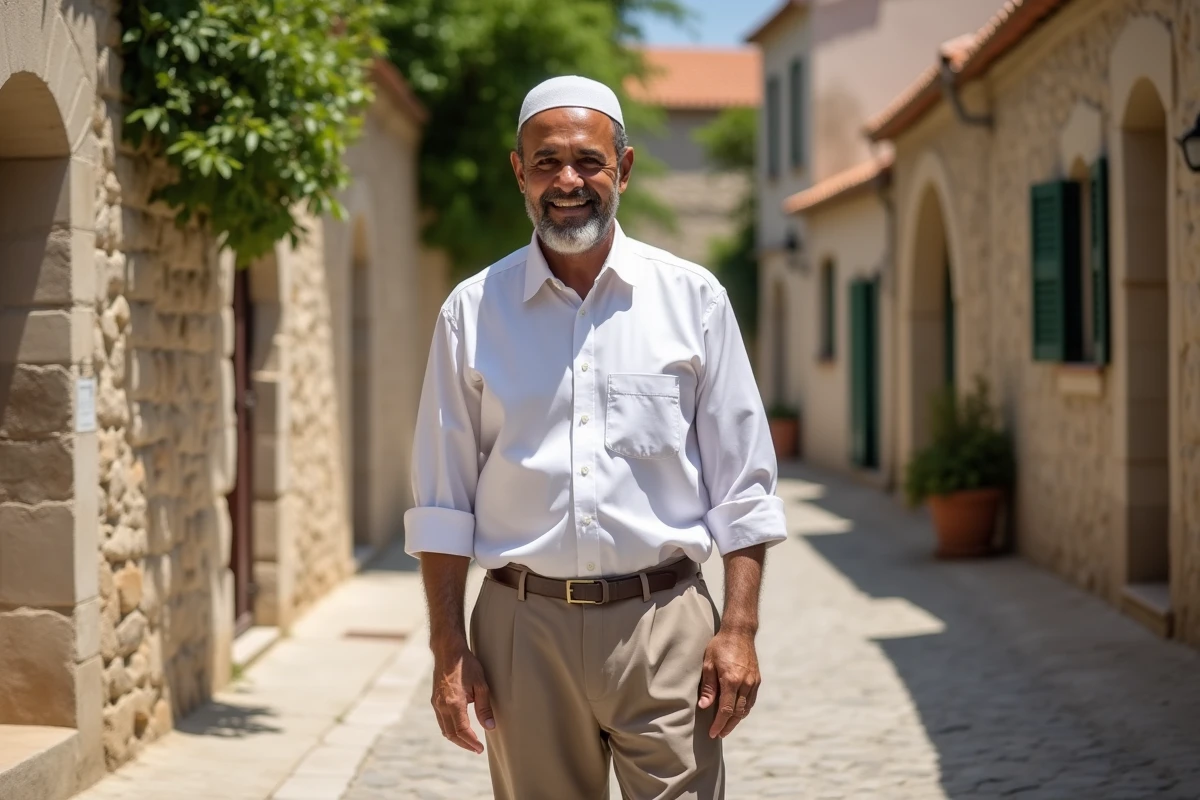
1% to 4%: these are the only figures that filter through, in the absence of official statistics, regarding the proportion of Muslims in Corsica. No one will engrave these estimates in stone, but they paint a picture of a discreet presence, largely overshadowed by the larger French regions.
These evaluations vary depending on how one defines belonging: family origin, practice, or simple cultural identification. The migratory history, characterized by irregular flows and slow integration, explains the low demographic visibility, while highlighting a real social presence.
What is the proportion of the Muslim population in Corsica today?
It is impossible to obtain an official figure: the census does not address the religious question. Staying true to the tradition of neutrality, Insee refrains from providing any data on religious affiliation. However, a few benchmarks allow for greater clarity.
Here is what the most reliable analyses show: the percentage of Muslims in Corsica remains low, generally between 1% and 4% of the population. This figure is constructed from several cross-referenced sources: immigrant population, Maghreb presence, evolution of migratory flows, local censuses concerning Moroccan, Tunisian, or Algerian nationals in cities like Ajaccio, Bastia, or Porto-Vecchio. The Muslim population primarily settles in urban centers, where employment attracts and families gather.
The situation in Corsica sharply contrasts with that observed on the mainland. Here, the Muslim presence, well established, remains limited in number. The explanation lies in the size of the island’s population, the specific migratory history, the dynamics of integration, and social habits. Families from the Maghreb or sub-Saharan Africa create a discreet but present landscape.
For those who wish to delve deeper, the page percentage of Muslims in Corsica expands on this panorama by comparing island realities, national trends, and migratory origins. The data confronts the complexity of the Corsican context, without masking the disparities with mainland France.
The history and establishment of Islam on the island: benchmarks and developments
Islam in Corsica establishes itself alongside the migrations of the 20th century. The first workers from the Maghreb are recruited for agriculture and large construction projects. In Ajaccio, Bastia, Porto-Vecchio, small communities form, weaving links between generations. The Muslim religious practice is primarily lived in the private sphere, between apartments and association premises, far from any visible institution.
The structuring of the Muslim worship gradually takes shape. While the first generation perpetuates its practices in intimacy, the 1990s see the emergence of the first stable places of worship: the Mohammed 5 mosque in Porto-Vecchio, prayer rooms in Bastia. Local figures, such as Billel Zakri or Miloud Mesghati, engage to give a voice to the community with the authorities or the French Council of the Muslim Faith (CFCM).
To this day, Corsican Islam is characterized by its discretion and strong social anchoring, much more than by a massive institutional presence. Associations prioritize supporting families, transmitting rites, and providing educational assistance. Religion is integrated into daily life, without seeking confrontation or visibility. On the scale of the island, everything is done on a human scale, in a logic of coexistence with local identity.
Understanding the demographic and cultural dynamics surrounding the Corsican Muslim community
Understanding the Muslim demographic dynamics on the island requires going beyond statistics. The figures, fragmentary, rely on the intersection of geographical origins and migratory movements. The majority of Muslim families come from Morocco, Algeria, or Tunisia, sometimes settled for two or three generations. Their journey is part of a dual approach: preserving the culture of origin while gradually adapting to Corsican society.
Several benchmarks help to better understand the functioning of the Corsican Muslim community:
- Strong family networks: the links between generations favor the transmission of values and support integration.
- Local associations, active mainly in large cities like Ajaccio or Bastia: they organize educational activities, prayer times, and solidarity actions.
- A constant effort to combine attachment to roots and adaptation to island life: the language of origin, religious practice, but also participation in local life.
Far from the large urban centers of the mainland, the Corsican Muslim population maintains a modest dimension but shapes a unique identity, between Mediterranean heritage and engagement in Corsican society.
The relationship to secularism, the management of pluralism, the question of discrimination, or the affirmation of Corsican identity influence daily life. The younger generations, often born on the island, grow up between multiple identities: French, Corsican, Muslim. National debates on separatism or the rise of the far right resonate in the background, but the local reality favors coexistence and dialogue. Here, the construction of a community of destiny is forged far from caricatures, at the crossroads of several worlds, in nuance rather than confrontation.